
The idea of building a website can feel like an insurmountable task that requires skills – coding, design, copywriting – that many of us just don’t have. This is especially true for very small business owners such as tradespeople and brick and mortar store owners. Conventional wisdom may suggest that a website needs to have multiple pages, complex designs and tens of thousands of words of content. But for many businesses, a one-page website is all that is needed to successfully grow a business online.
Continue reading to learn about the pros and cons of one-page websites, as well as best practices for making a one-page website work for you.
What is a one-page website, exactly?
At risk of oversimplification, a one-page website is exactly what it sounds like: A website consisting of a single page! When successfully designed, a user can access all of the content via scrolling or anchor links instead of clicking through to other pages.
One-page websites are incredibly easy to build and maintain and highly cost-effective for beginners who want to establish a digital footprint without breaking the bank. By keeping everything on a single continuous page, you ensure that users get the entire story on a single page. They do not have to hunt for information or wait for new pages to load.
What are the best use-cases for a one-page website?
Not every project fits a one-page mold. Large ecommerce stores, blogs and websites for complex B2B products and services come to mind. However, a single-page structure shines for these use cases:
- Local businesses: Local brick and mortar businesses and trades people typically don’t need a massive web presence. A one-page website highlighting products and services, hours of operation, contact information and promotional content is often all that is needed to thrive online.
- Personal portfolios: A single page provides a quick snapshot of your work, your background, and your contact information. It is the perfect digital business card for freelancers and creatives.
- Event pages: Websites for weddings, industry conferences, and workshops benefit from a linear layout. You can list the schedule, speaker details, and registration form all in one easy-to-scroll location.
- Sites that support apps: A one-page site is a great way to get exposure for mobile applications that live within the walled gardens of an app store. Registering a relevant .app or .io domain gives your product a memorable home on the web.
What are the pros and cons of a one-page website?
While one-page websites can be a natural fit for many projects, there are some important considerations. Here are some pros and cons to help you make the right decision.
Pros of a one-page website
- Simplicity: Building a one-page website is a much lighter lift, requiring less content, design and technical skills, especially with today’s beginner-friendly website builders.
- Usability: Since many people access websites via a mobile phone or device, scrolling can be preferable to clicking from page to page, making one-page websites a more user-friendly option.
- Conversion: The goal of many small business websites is simple: generate calls, form fills and/or foot traffic. Large websites that require visits to multiple pages before taking action can actually reduce conversion rates by distracting or frustrating users.
- Cost: One-page websites offer many cost savings over larger websites, from lower hosting costs to streamlined creation and management costs.
Cons of a one-page website
- Search engine optimization (SEO) challenges: Perhaps the biggest argument against a one-page website is the disadvantage related to search engine optimization (SEO). Large, multi-page websites with more content spread across multiple pages get more exposure in search results and, ultimately, more organic traffic. But not all websites need organic traffic in order to thrive. For instance, local businesses can still bring in highly qualified traffic through other channels such as Google Maps, social media and search engine marketing (SEM).
- Storytelling: Creating a one-page website is not without its content and design challenges. People who are new to creating a website may struggle with consolidating their ‘story’ onto a single page. We offer some tips below, in the section ‘How to build an effective one-page website’:
- Scalability: As businesses grow – adding products, services and locations – websites also need to grow. A one-page website may outlive its utility, requiring a pivot to a new strategy down the road. Many would argue that this is a good problem to have!
How to build an effective one-page website
Because you do not have separate pages for different topics – about us, services, pricing, etc. – you must break down the essential information into brief, easily digestible sections. A successful one-page website should follow this blueprint:
The ‘hero’ section
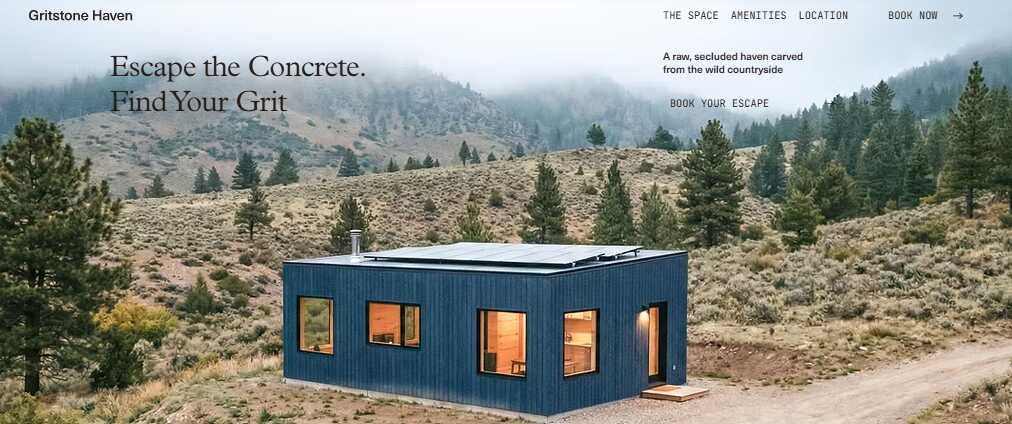
This is the top section of your website – what users first see when they arrive at your site. It needs a bold headline, a supportive subheadline and a clear call to action. Also consider an inviting and compelling image that supports the headline. The hero section must immediately tell the visitor what you do and what step they take in order to become a customer.
The ‘about’ narrative
Right below the hero section, include a concise story – one to two paragraphs at most – that builds trust. Share your mission and your background. And tell the user why they should use you instead of your competitors. Consider using text formatting (i.e. bold and italics) and design (i.e. graphical icons) to highlight key messages that differentiate you from your competitors – whether it’s your low price, years of experience or fast response time.
Products and services
Use icons, bullet points, or visual cards for easy scanning. Visitors want to know exactly what you offer without reading massive blocks of text. Breaking your services into distinct snippets keeps the design clean and scannable. If pricing is an important consideration, consider including it here or creating a dedicated section directly below that provides more detail.
Testimonials and social proof
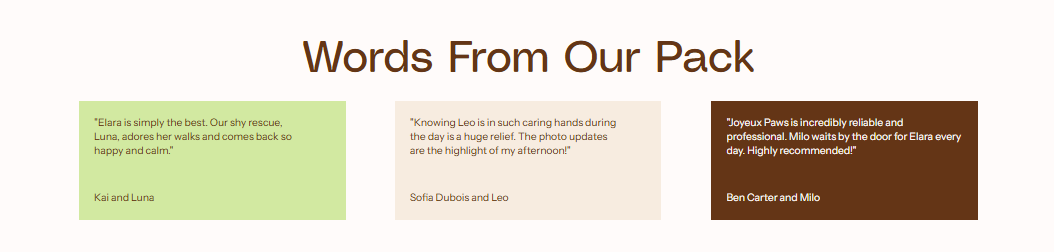
You need to offer validation without the clutter. Include two or three powerful quotes from happy customers. Social proof shows potential customers that you have a proven track record – a huge signal of trust. Have good Google reviews? Or Trustpilot ratings? Include them here as well!
Frequently asked questions (FAQ)
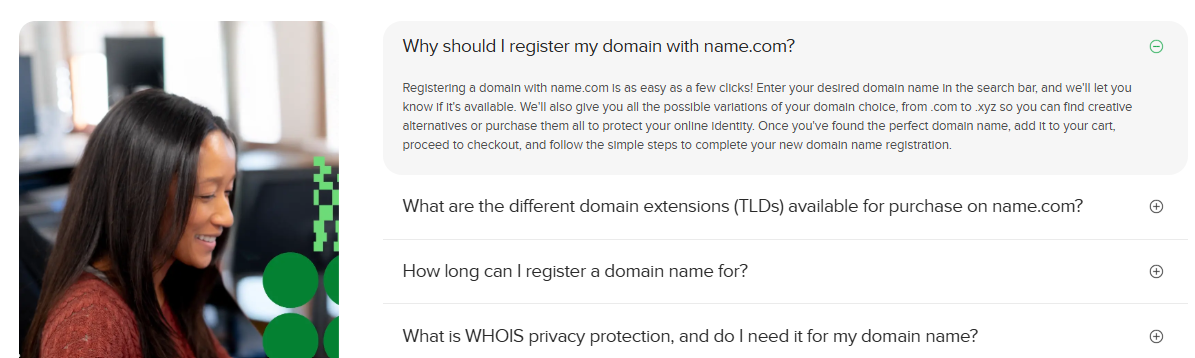
An FAQ section is a great place to address commonly asked questions that aren’t addressed in other sections of your site. Many small businesses will use the FAQ section to help answer questions that come in via calls and form inquiries, reducing the burden on front office staff.
The floating header
Most websites today have a header section that contains the main navigation – the links needed to access pages across the website. Look no further than our website – name.com! Notice how the header navigation remains visible as you scroll down the page. This is a purposeful design element called a floating (or persistent) header, and it gives users access to the main navigation no matter where they are on the page.
For a one-page website that doesn’t need a navigation menu, the header is where you can provide a call to action – your phone number or a form link – as well as hours of operation, your address and links to your social platforms. Keeping this info in front of users at all times can maximize your conversion rates!
Anchor links
You probably associate a hyperlink as clickable text that takes you to a new page. But hyperlinks can also be set up to take you to different sections on the same page, and they are an excellent way to make it easy for users on your one-page website to easily find the information they need without scrolling. Use hyperlinks in your ‘hero’ and ‘about’ sections to push users to relevant sections that are further down the page.
Making the choice for your brand
Deciding on your website structure comes down to your primary goals. Ask yourself if your main objective is information density or user action. If you need to educate your audience with hundreds of articles, a traditional layout is necessary. However, if you want a fast, beautiful, and focused experience that drives a specific action, a one-page website is the way to go. It empowers you to master your personal brand, engage your audience effortlessly, and grow your business with confidence.

Dark mode
Let's keep in touch.
You can opt out at any time. By clicking “Subscribe”, you agree that you have read, understand, and consent to the Privacy Policy with regards to the use of your personal data